
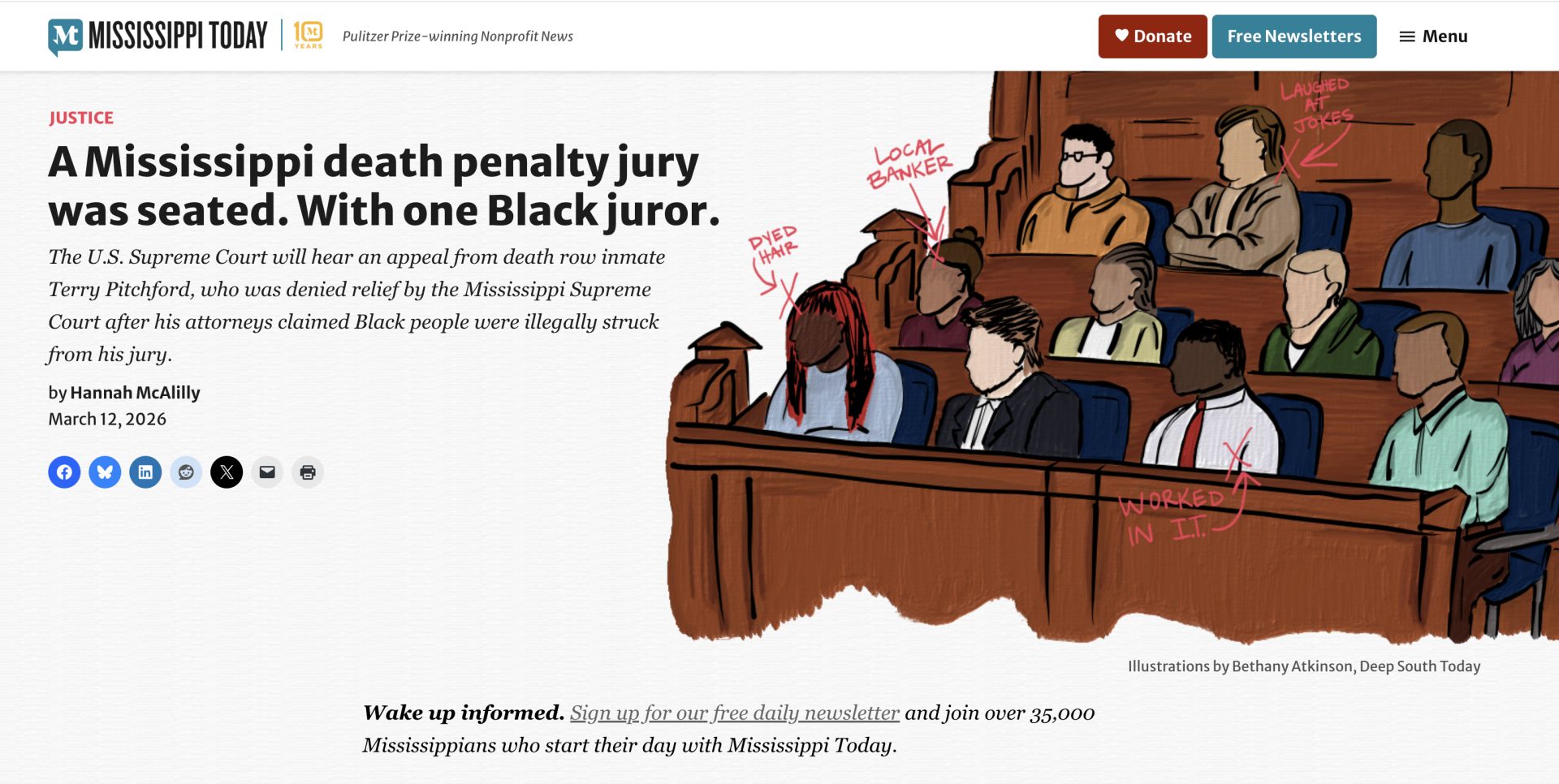
The judges had a clear favorite in the Feature, Medium Newsroom category – A Mississippi death penalty jury was seated. With one Black juror – by Deep South Today. The U.S. Supreme Court’s 1986 Batson decision was supposed to increase the chance of juries being more racially balanced. But that didn’t happen in the case of Terry Pitchford. Deep South Today investigated why his jury only had one Black juror. This story helped propel the case all the way back to the Supreme Court, which ended up ruling in favor of Pitchford in a 5-4 decision. It was a major investigative/public-interest question that also delves into the people whose lives make the question matter. The judges liked the story’s interactive components, especially the “Would you survive jury selection in Mississippi?”
In 2025, Leslie King, the sole Black justice on the Mississippi Supreme Court, lamented that Black defendants could not get a fair hearing anywhere in the state on the issue of Black people being illegally struck from juries. The issue is known as a “Batson violation,” named after the 1986 U.S. Supreme Court decision Batson v. Kentucky that prohibited jury strikes based on race.
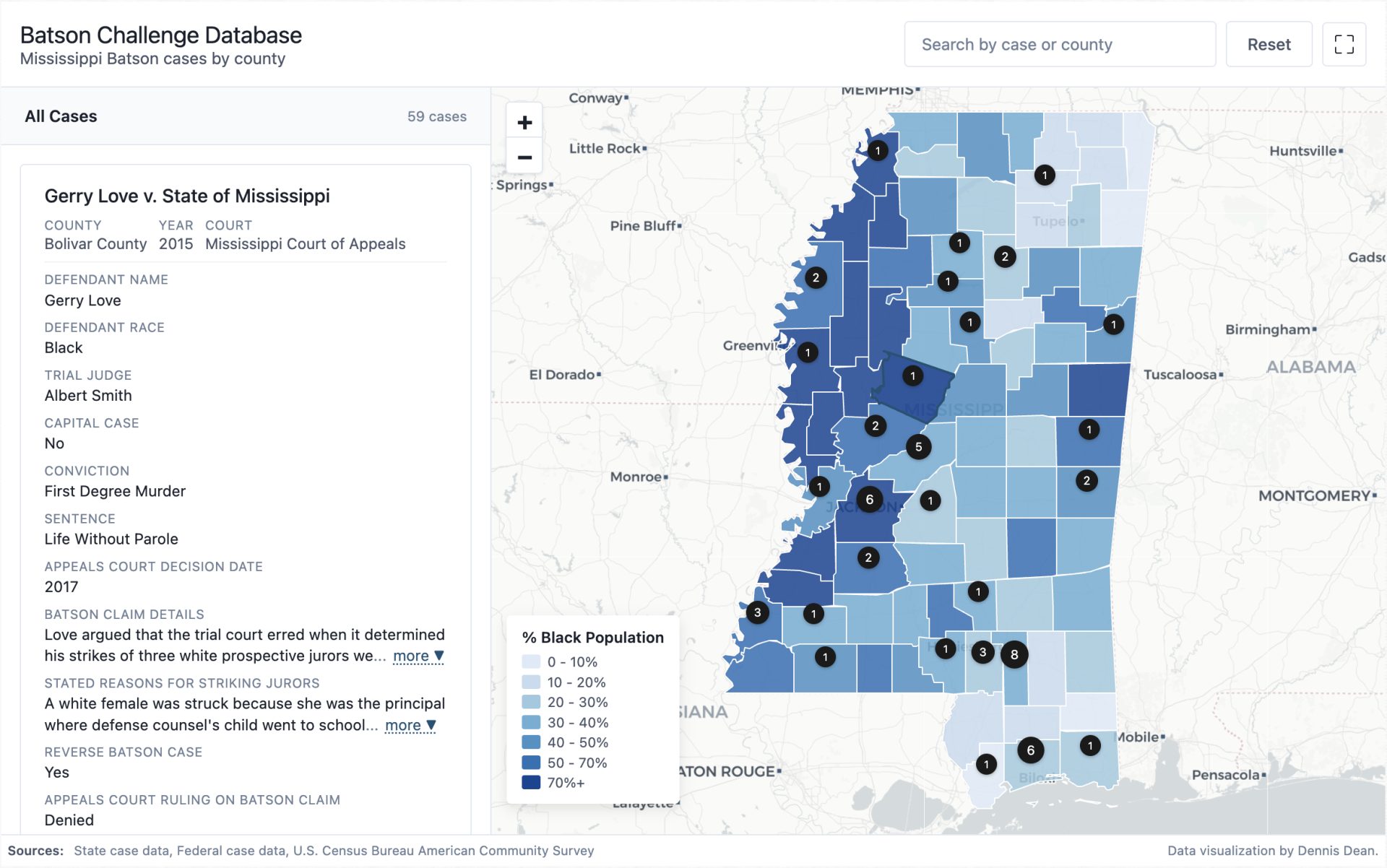
Deep South Today engaged veteran investigative reporter Hannah McAlilly to investigate King’s claim. Hannah analyzed criminal appeals considered by the Mississippi Supreme Court, the Mississippi Court of Appeals and each of Mississippi’s federal districts from 2015 to 2025. The analysis identified approximately 60 appeals and petitions seeking post-conviction relief where Batson claims were raised, including 18 heard by the Mississippi Supreme Court.
According to the review, over the last decade the Mississippi Supreme Court hasn’t provided relief in a single Batson claim, allowing prosecutors’ strikes of Black prospective jurors to stand in every case it’s considered, even in the wake of the U.S. Supreme Court’s much-heralded decision in 2019’s Flowers v. Mississippi.
The review also included trial transcripts. In one case, a prosecutor struck a Black man who worked as an IT manager because he said IT employees weren’t “perceptive,” while another struck a Black woman for working at a parochial school. A Black woman who worked at the Mississippi Department of Health was struck because she “failed to indicate how long she had been employed” on her juror questionnaire.
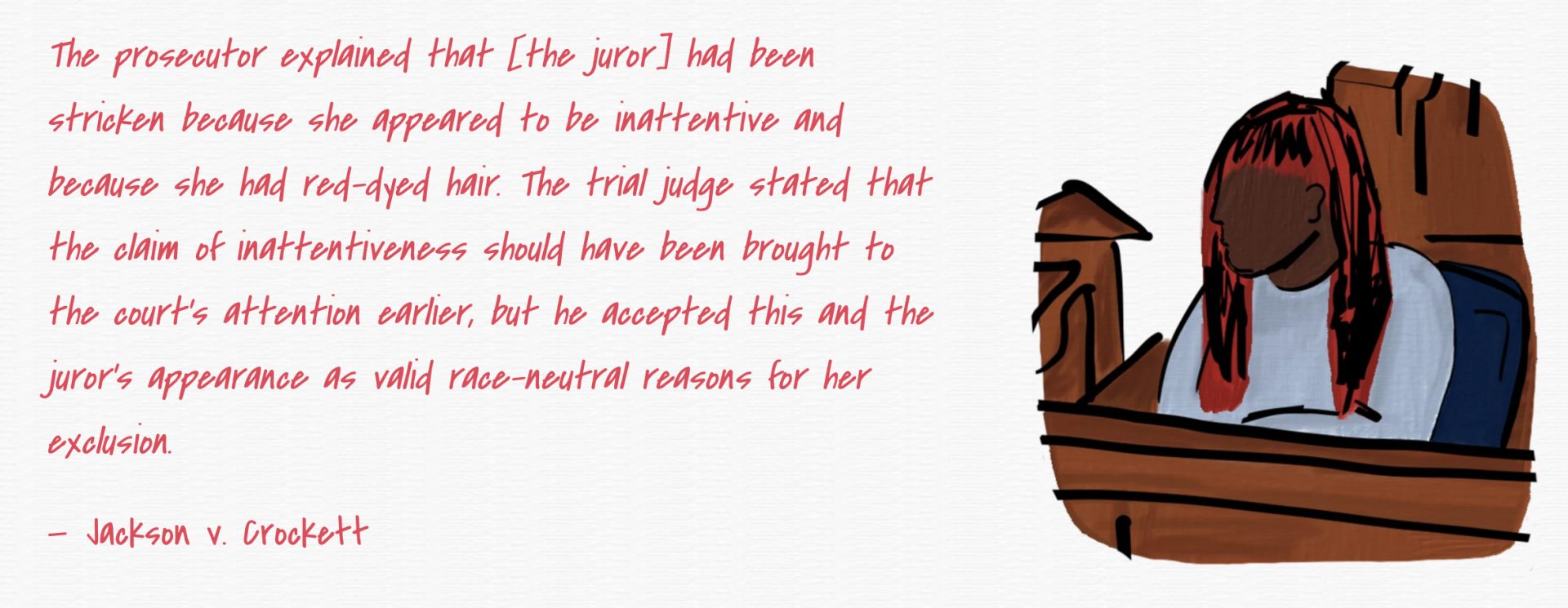
In another case, a prosecutor struck a Black woman for having “red dyed hair” and in another, a prosecutor struck a Black man because he had “a ponytail, a sort of strange hair design.” That prosecutor told the judge he was concerned the juror might identify too closely with the defendant, who also was of a similar age. “Both have unusual hair styles,” the prosecutor said.
A Black woman was struck because the prosecutor didn’t like her “vibe.” Another, who worked a night shift before showing up to jury selection, was struck for being “fidgety” and looking “angry.” Another was struck because she “frowned a lot.”
The piece also focused on a death penalty case involving Terry Pitchford, a 20 year-old Black man accused of killing a beloved white convenience store owner. When prosecutors finished jury selection in Pitchford’s case in 2006, just one Black person was on his jury. The prosecutor in the case struck Black people for myriad reasons including unproven allegations of “mental problems.”
With its original data analysis of federal and state court records, examination of trial transcripts and interviews with legal experts and key players in the Pitchford case, this piece is a powerful, unprecedented-in-scope examination of the crisis of Batson violations in Mississippi.