
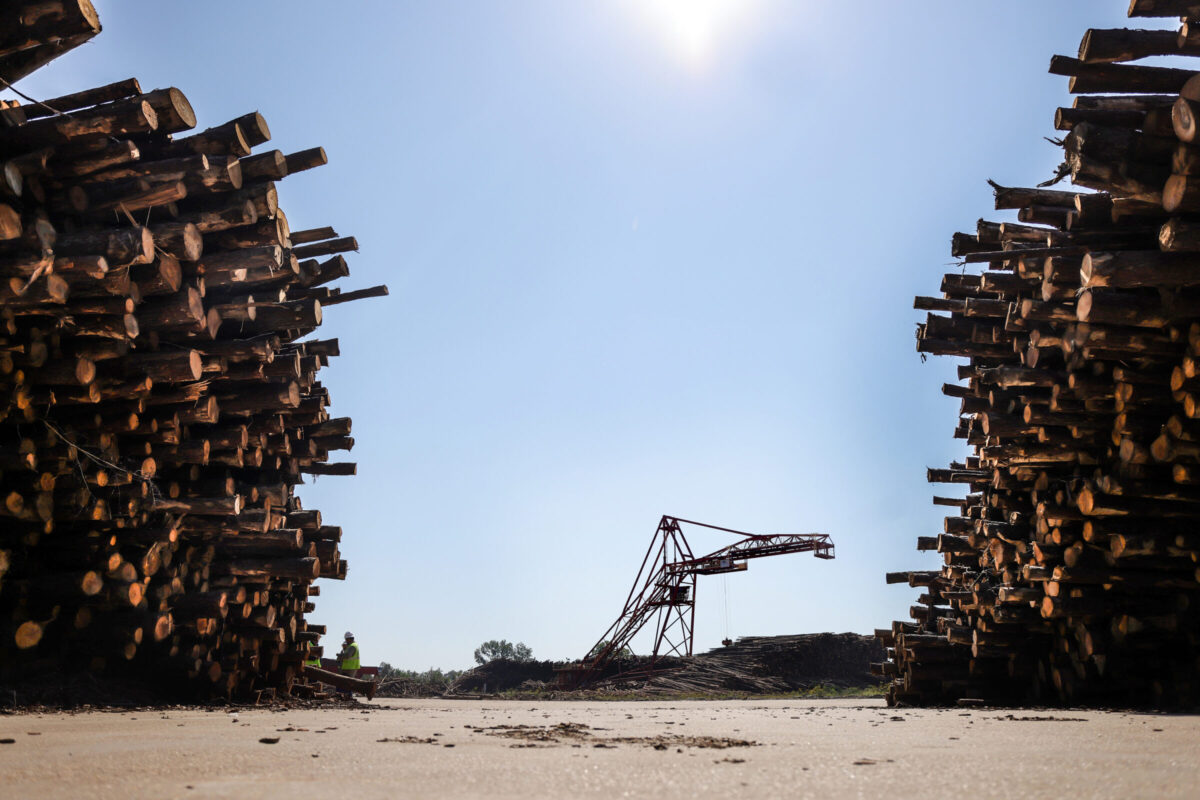


“Burned” is a three-part explanatory series that illuminated the hidden costs of a rapidly expanding industry operating largely outside public scrutiny in the Deep South. By linking pollution concerns in poor, predominantly Black communities in Louisiana and Mississippi to international climate policy and corporate practices, the series offered readers a nuanced examination of whether the biomass industry truly delivers on its promise of producing a clean, renewable alternative to fossil fuels.
Produced in partnership between Verite News and Grist, the series involved reporting trips to north Louisiana and central Mississippi, where trees are processed into wood pellets, and Yorkshire, England, where those pellets are marketed as “sustainable biomass” and burned in a former coal plant owned by U.K. energy giant Drax.
We spent days in each community, building trust and documenting dozens of residents’ lived experiences. We treated those accounts seriously while also testing them against scientific and regulatory evidence. Their personal stories about persistent noise, dust, and declining health aligned with scientific research, public health data showing elevated rates of cancer, asthma, and heart disease, as well as a growing record of air pollution violations at nearby pellet mills.
Hundreds of pages of permit histories, legal filings, emissions data and company records revealed a pattern of large-scale toxic emissions met with complacency by state regulators. In some cases, mills received expanded emissions permits that matched pollution exceedances that had gone untested and unpenalized for years.
The series also contrasted industry promises of economic revival with conditions on the ground in mill towns. We showed how Drax strategically located mills in economically devastated towns where residents and local officials were desperate for jobs after traditional pulp and paper mills closed. We revealed for the first time that Louisiana granted Drax roughly $75 million in property tax exemptions intended to spur employment. But the few jobs that materialized were often low-paying and harmful to workers’ health, and the well-paying technical positions went to workers living far from the pollution.
In England, we examined a parallel transition in former coal towns now tied to an energy industry promoted as “green.” But many residents remain deeply skeptical – and for good reason. The biomass boom was enabled by a regulatory loophole that diverted billions in renewable-energy subsidies from wind and solar to the production of wood pellets. Through interviews with scientists and energy experts, we also explained why burning wood is worse for the climate than burning coal — a reality that has struggled to gain traction among European policymakers racing to meet aggressive emissions-reduction goals.