
LA NACION is one of Argentina’s oldest newspapers, with more than 150 years of history. In addition to being a leading voice in politics, economics, anticorruption and major news coverage, recently we have developed a long term strategy to integrate a climate perspective across different verticals, while continuing to push new boundaries in the ethical use of AI in reporting and workflow processes throughout the company.
Since July 2020, we have also been proud members of The Trust Project.
Examples of User Interface & Interactive Innovation
1. Government Corruption
This award winning multimedia investigative project reconstructed, with unprecedented detail, the 1995 explosion of the Río Tercero Military Factory, one of Argentina’s worst corruption cases. Initially presented as an accident, Justice later ruled it a deliberate act to hide illegal arms trafficking linked to high-ranking officials during Menem’s presidency.
Using judicial records, expert reports, archives, and fieldwork, the team recreated the events as an immersive narrative experience. The project reveals the scale of the tragedy while helping younger generations understand a politically significant event long kept partly hidden.
2. Science & Climate Change
This investigative project reconstructs the catastrophic flooding of Bahía Blanca, one of Argentina’s most extreme recent disasters, when a year’s worth of rain fell within hours. Combining meteorological data, satellite imagery, geographic analysis, expert input, field reporting, and more than 100 verified user-generated videos, the piece explains why the city flooded so dramatically.
Through an hour-by-hour reconstruction and a central 3D model, the investigation shows that the disaster resulted not only from intense rainfall, but also from urban topography, drainage limitations, and water flow into a flat, densely built area. By turning complex scientific processes into accessible storytelling and interactive visualizations, the project helps audiences understand both the causes of the flood and the broader risks of extreme weather and urban vulnerability.
3. Social Inequality: Jobs that change lives.
Only 3 out of 100 young people from Argentina’s poorest neighborhoods secure formal employment. To address this, LA NACION launched a multimedia project highlighting how formal jobs transform lives and help companies through greater commitment and retention. The initiative featured research, success stories like Aaron’s, and campaigns encouraging companies to hire vulnerable youth, showing that formal employment can lift entire families out of poverty.
Examples of creative use of online technology.
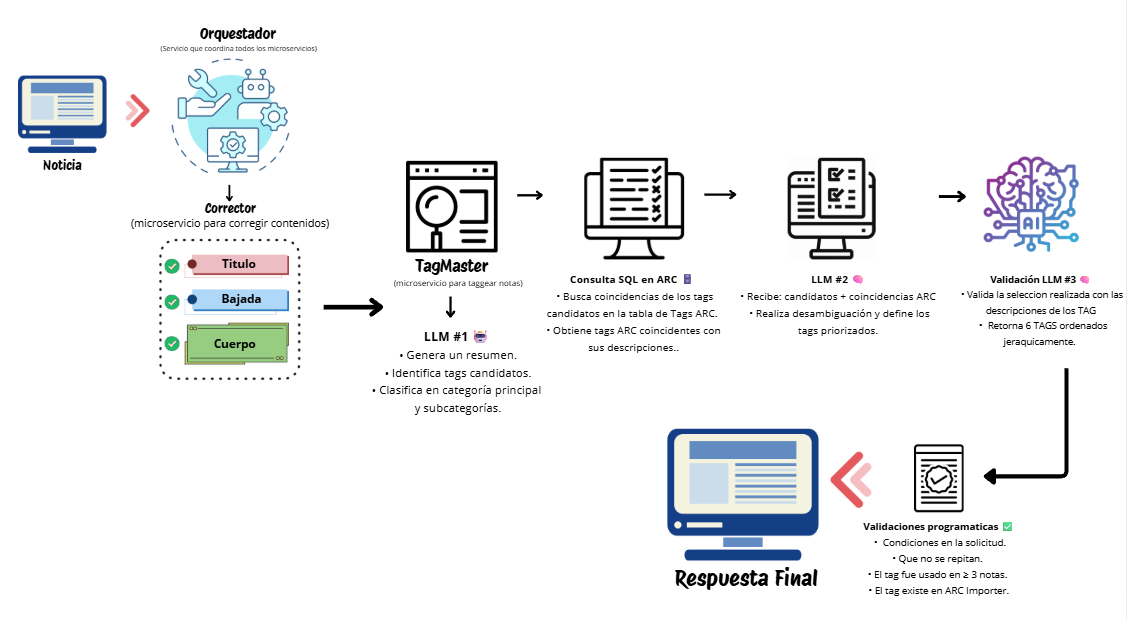
LA NACION is integrating Generative AI across multiple areas of the organization to enhance editorial and visual products, streamline workflows and improve accessibility.
Developed collaboratively by the Data & AI Core Lab, Product & Technology, Data & Analytics, Audience & Insights, and the Newsroom, key implementations include:
a) an in-house toolbox for content creation; b) an ARC Composer Chrome add-on with an integrated copy editor; c) an automated self-tagging system; d) a self-hosted n8n automation service connected to large language models that helped produce our more impactful 2025 AI assisted investigation; and e) AI agents designed to automate and improve editorial and operational workflows.
A link is provided with further information about the behind-the-scenes examples of above mentioned projects and their impact, in English.
Strategy
Over the last 20 years, we have worked to transform newsroom culture — from print to digital platforms, audiovisual storytelling, social media, data journalism, and AI. Each technological shift has been embraced as an opportunity to strengthen our journalism and better connect with our audience.
In 2019, we decided to deepen our understanding of the climate and biodiversity crisis by translating scientific knowledge for both our newsroom and the general public. Although it began as a content challenge that could have led to the creation of a new environmental vertical, its impact across every editorial section has driven a broader cultural transformation, much like the one we experienced with previous technological shifts.
To achieve this, we created The Nature Project, a cross-sectional initiative that combines multimedia storytelling and open collaboration with environmental NGOs.
Impact
In 2025, the most direct sign of impact came two days after one AI supported publication. On August 4th, President Milei publicly committed to stop using insults, addressing LA NACION’s reporting prior to midterm legislative elections. “I am going to stop using insults, to see if they are capable of discussing ideas, because I think they argue about form because they lack the intellectual level to discuss ideas,” he said at an NGO’s dinner.
After this public announcement we continued to monitor his discourse that effectively diminished the use of insults. After the election took place, he returned to his violent speech. (Behind the scenes and methodology.)
Río Tercero Explosion. Metrics reflected strong interest in a story that marked Argentina’s history and had never been told with such depth. The piece reached nearly 40,000 pageviews on publication day (versus an average of 12,000), with 62% coming from subscribers. Average reading time exceeded benchmarks at 4 minutes and 3 seconds, showing strong engagement. The article also generated a record 340 comments, with readers sharing memories and appreciation for revisiting an event that should not be forgotten.
Bahía Blanca Flooding. The project featured during the disaster’s one-year anniversary, reached over 30,000 users and generated more than 40,000 pageviews, with an average engagement time of 1 minute and 30 seconds. It also sparked strong social media engagement, especially among the city locals and the data journalism, environmental, and meteorological communities, where experts praised its methodology and contribution to understanding the event beyond official data.
Jobs that changed lives. Today, several young people from underserved communities are working in their first formal jobs. The project reached more than 100,000 pageviews and over 987,000 accounts on social media. As a result, more than 50 companies signed up to hire young people from low-income families mentored by Fundación Forge.