


When President Donald Trump returned to office and launched his mass deportation campaign, a troubling duality emerged. The government repeatedly made sweeping claims that it was targeting the “worst of the worst” criminals but refused to give the public the information it needed to assess whether those claims were true.
The stakes could not have been clearer in mid March, when the administration sent more than 230 Venezuelan migrants it claimed were gang members to CECOT, a brutal maximum-security prison in El Salvador. The men were given no chance to challenge their removals to a country many had never even set foot in before. ProPublica, in partnership with independent Venezuelan journalists from Alianza Rebelde Investiga and Cazadores de Fake News, used every tool available – and developed new ones – to bring attention to their plight in ways that set us apart from a very crowded field of competitors.
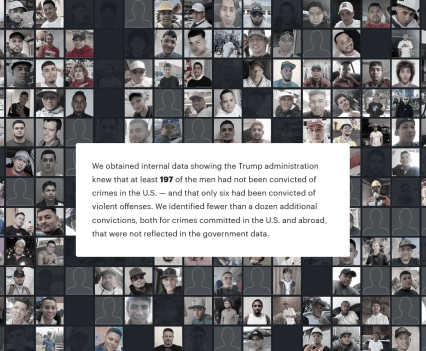
No other news organization produced as comprehensive or detailed an accounting of those immigrants. With enormous contributions from our research, data and news apps teams, and a small army of freelance reporters, we interviewed relatives of more than 100 of the men and obtained hundreds of records about them in the U.S. and South America. We wrote about internal government records we obtained that showed the majority of the men had no violent criminal records and that the government was aware of that fact when it banished them to a foreign prison. We also, through an exclusive analysis of court data, wrote about how the men were not hiding from authorities when they were arrested and deported, but were instead moving through the nation’s immigration system.
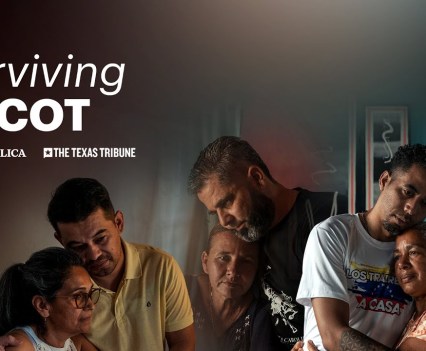
Perhaps the most novel effort involved our creation of a searchable database that included detailed backgrounds of the men and allowed the public to examine the detainees’ records for themselves. And because we had developed relationships with so many of the men’s families, we were able to quickly produce a powerful story days after their release that included their testimonies of torture. We also produced a film that was the first to capture the men on camera describing the physical and mental torture they endured inside CECOT and the agony their relatives suffered during their detention.
Taken together, our coverage showed incontrovertibly that the overwhelming majority of the men who’d been banished to prison in El Salvador had no violent criminal records and were targeted by our government even as they tried to follow the rules. It’s a cautionary tale for us all, one that ProPublica’s staff went to tireless lengths to cover.