

This was an excellent use of AI for sensemaking, tackling an obvious gap by analyzing thousands of hours of podcasts at a scale that would otherwise be incredibly difficult. Judges were impressed by how the reporting extracted real meaning from a massive media landscape and turned it into authoritative, accessible and compelling journalism.
Some of the most important voices in American politics now operate on podcasts. Hours of conversation every week shape how millions of people think about elections, policy and power. But the podcast world is opaque. There’s no database of shows, no searchable archive of what was said. In order to understand this growing world, reporters have to sit there—and listen. For hours.
This became acutely clear over the summer, when the Epstein scandal temporarily fractured President Trump’s relationship with his base. Across dozens of conservative podcasts, MAGA’s most prominent voices—Alex Jones, Glenn Beck and Joe Rogan—began openly defying the president. “Are you still talking about Jeffrey Epstein?” Trump scolded reporters. But his supporters kept talking.
WSJ reporters wanted to understand the scale of this schism. Who was saying what? When did the breaks occur? How did the narrative shift, week by week? The answer involved analyzing more than 22,000 episodes across 150 shows, tracking exactly when each mention spiked—after a DOJ memo, after Elon Musk’s accusations, after each new revelation.
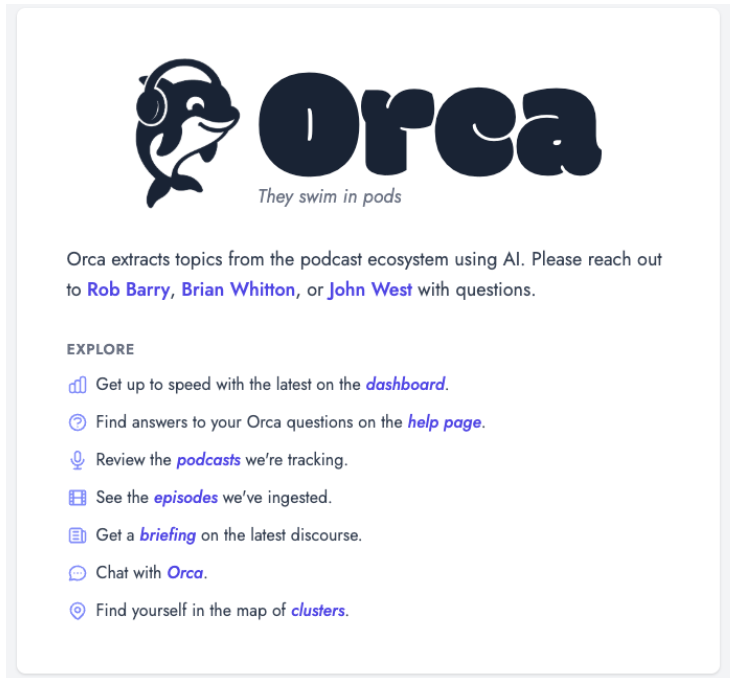
To help map this previously unsurveyable territory, we built ORCA.
Implementation
ORCA (“They swim in pods”) monitors podcast feeds and automatically downloads new episodes as they’re published. Each episode is transcribed using AI that identifies individual speakers, so reporters know not just what was said, but who said it.
Google Gemini analyzes each transcript, generating multiple summaries and identifying the topics discussed. Each week, the system creates briefings that aggregate what’s being talked about across groups of podcasts—“politics,” “AI,” “extremist content” or any custom selection.
Reporters can use a chat interface to search and ask questions in plain English. The system’s answers include links to the exact moment in the podcast where the information came from, letting journalists easily verify facts before publication.
A clustering system groups similar episodes together, helping reporters spot emerging narratives and track how ideas spread across the ecosystem.
Innovation
ORCA opens up an ecosystem previously impossible to search. For the first time, WSJ reporters can:
Track where ideas come from. When an unusual phrase shows up in a politician’s social media post, reporters can search ORCA to find where it appeared, mapping how talking points move from fringe podcasts to mainstream political discourse.
Get briefed. Weekly AI-generated custom briefings surface what matters across hundreds of hours of content so reporters learn what’s happening on their beat without having to hunt for it.
Find who said what. Because ORCA identifies speakers, reporters can search for every podcast appearance by a specific person—a powerful tool for finding quotes and tracking someone’s public statements over time.
Spot trends as they emerge. The system groups similar content together, making it easy to see when a topic is gaining momentum or when a new narrative is taking shape.